


KaRaL
Portable Field Gas Exchange System
Rapid single-leaf measurements for high-throughput field trials
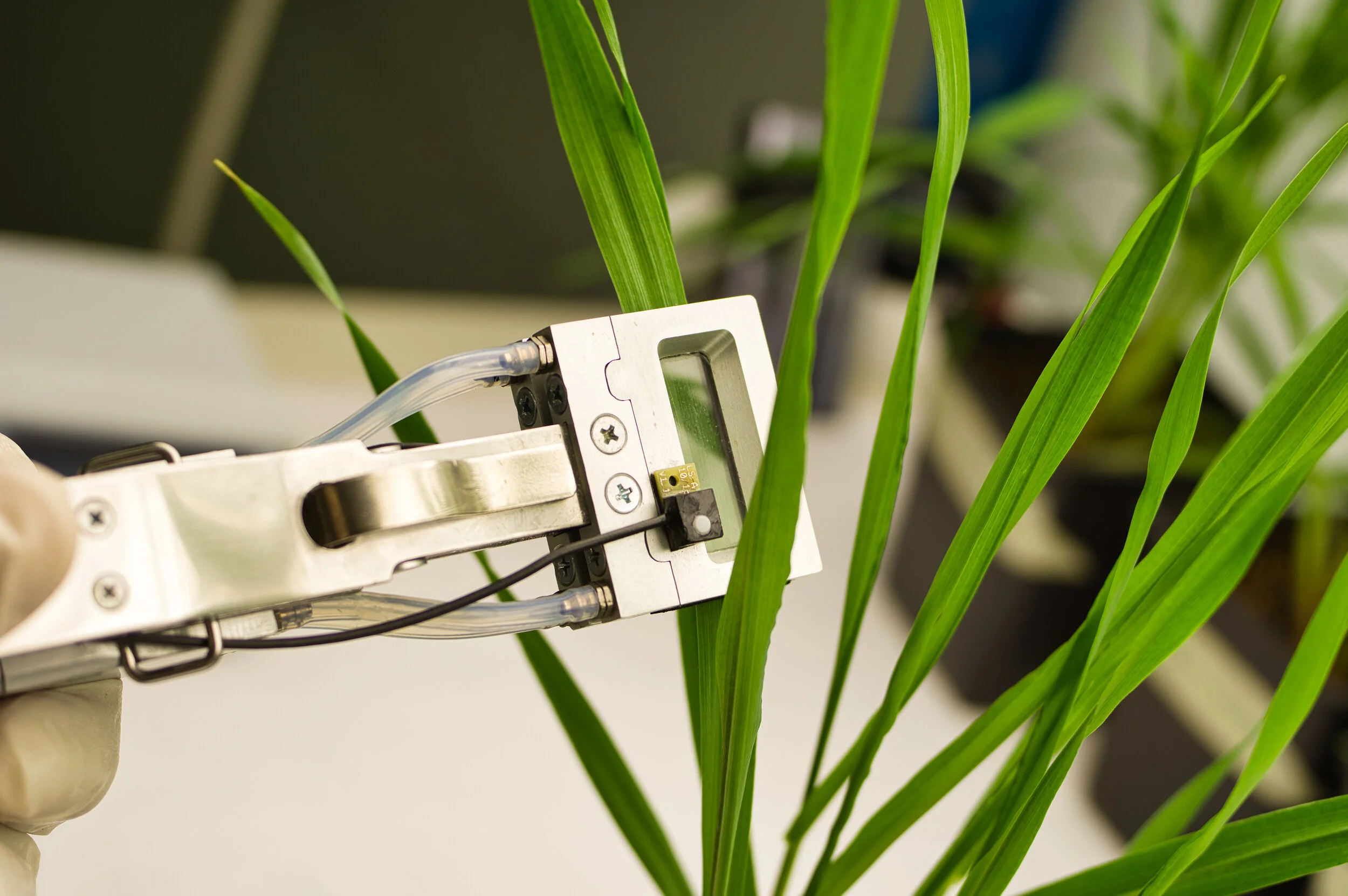
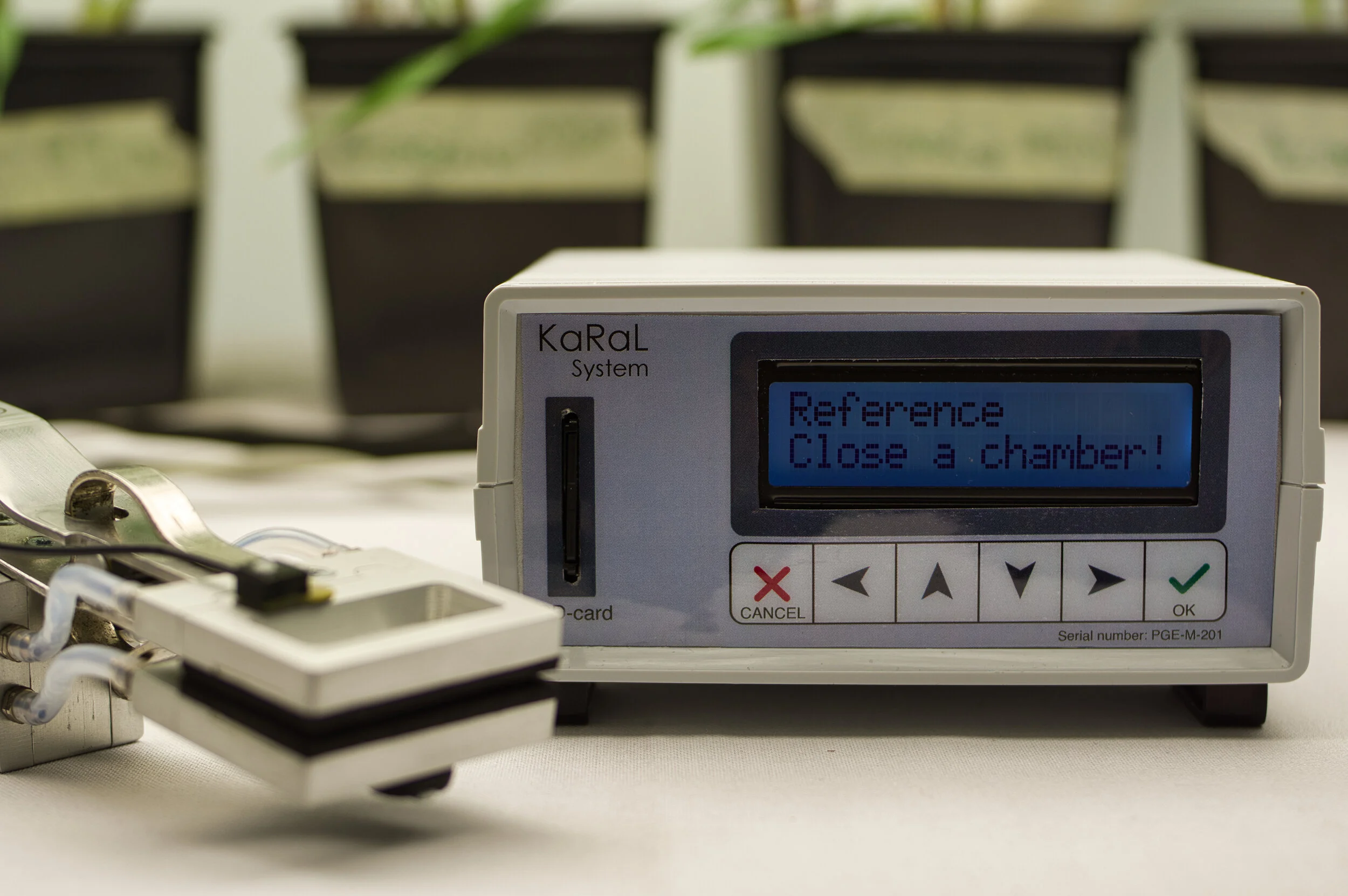
KaRaL is a portable system for rapid, non-destructive measurements of attached leaves under field conditions. It measures net photosynthesis, transpiration and stomatal conductance while recording light, leaf temperature and ambient temperature. A lightweight measurement head, backpack unit and Android app help researchers collect comparable physiological data across many leaves, plots and plant lines.


Details
KaRaL is a portable single-leaf gas-exchange system for rapid in situ measurements across field plots, cultivars and experimental lines.
At a glance
Rapid point measurements of many attached leaves
A reliable sample value in approximately 8 seconds
About 20 leaves measured from one reference-air fill
Lightweight 370 g measurement head with backpack unit and Android app
What KaRaL measures
Net photosynthesis (Anet)
Transpiration (E)
Stomatal conductance (gs)
PAR / PPFD, leaf temperature and ambient temperature
Built for field trials
KaRaL prioritizes throughput and portability. It captures short gas-exchange snapshots under ambient field conditions, helping researchers average measurements across a plot without removing leaves from plants.
How measurements work
Ambient air from a field plot is collected in an impermeable reference bag. The system first measures the reference CO₂ and H₂O concentrations. An attached leaf is then clamped in the cuvette and the same air passes over it. Differences between the reference and sample air are combined with airflow and leaf area to calculate Anet, E and gs.
Measurement head and cuvette
Cuvette area: 3 cm² (3 × 1 cm)
Cuvette volume: 0.75 cm³
Distance from glass to leaf: 1 mm
Head dimensions: 23 × 5 × 5 cm
Head weight: approximately 370 g
Flow rate: 5.5 mL s⁻¹
Boundary-layer conductance: 2,650 mmol m⁻² s⁻¹
Rapid, non-destructive sampling
Reliable sample value in approximately 8 seconds
One reference-air fill supports about 20 leaf measurements
Leaves remain attached and in their natural orientation
Sensors and precision
PAR sensor: ±0.1 µmol m⁻² s⁻¹
Infrared leaf-temperature sensor: ±0.1 °C
Flow meter: ±0.1 mL s⁻¹
IRGA CO₂ and H₂O readings: ±0.1 ppm
Portable system
3 L reference-air container
5 L min⁻¹ pump
50,000 mAh portable battery
Mini-controller for field operation
Data and app
The KaRaL 2.0 Android app connects to the system by Bluetooth. It supports plot and sample naming, displays the calculated results and stores both calculated TXT files and raw LOG files for later analysis.
Research applications
Plot, cultivar and genotype screening
Field photosynthesis, transpiration and stomatal-conductance surveys
Frequently asked questions
How quickly can KaRaL measure a leaf?
In the documented field protocol, a reliable sample value is obtained in approximately 8 seconds after the leaf is clamped. Actual throughput depends on the sampling plan and field conditions.
What does KaRaL report?
The system calculates net photosynthesis (Anet), transpiration (E) and stomatal conductance (gs). It also records PAR / PPFD, leaf temperature and ambient temperature.
Does KaRaL control the measurement environment?
No. KaRaL is designed for rapid point measurements under ambient field conditions. The reference-air system provides a stable baseline, while the light and temperature sensors add environmental context to each measurement.
Are the measurements destructive?
No. The leaf is measured while attached to the plant and can remain in its natural orientation, allowing further measurements or analysis.
What is included in the portable system?
The system combines a lightweight measurement head with a backpack unit containing the IRGA, reference-air bag, pump, controller and power supply. An Android phone running the KaRaL 2.0 app controls the workflow.
How are data stored?
The Android app stores calculated values in TXT files and the underlying raw measurements in LOG files, making the data available for quality checks and further analysis.
Developed for high-throughput field phenotyping
KaRaL was developed in collaboration with the University of Tartu. A published BEST-CROP field protocol describes analysing 28–32 plots during a four-to-five-hour measurement period, illustrating the system’s intended high-throughput workflow.