



Jyrkki
System for measuring small plants
Jyrkki MAX
System for measuring crop plants
KaRaL
Portable field device
Our technology

-
Plants take up CO2 from the atmosphere to produce biomass through photosynthesis and transpire water and oxygen. The rate of CO2 uptake is measured as net carbon assimilation (Anet) and transpiration of water (E) can be converted to stomatal conductance (gs). These plant traits can easily be assessed using gas exchange methods that are non-invasive, direct and offer a wide range of possibilities for experiments. We offer both multi-chamber solutions Jyrkki and Jyrkki MAX for laboratory use and single leaf measurement system KaRaL, for intensive high-throughput field trials
-
Water vapour and CO2 exchange patterns of unharmed plants are contiuously measured in the cuvettes. This is done by dividing the air entering each cuvette into two streams - one going directly to analysers and the other passing through the cuvette before leading to the analyser.
Net assimilation rate (Anet ) and transpiration (E) are calculated as follows:Anet= air flow rate*(CO2in-CO2out)/leaf area
E= air flow rate*(H2Oout-H2Oin)/leaf area
Total leaf conductance (gt) to water vapour is calculated as (von Caemmerer & Farquhar, 1981):
gt=E/(H2Oleaf-H2Oair)
The air temperature in the cuvettes is measured to determine the leaf temperature for the leaf-to-air humidity gradient in the equation above, from where leaf temperature is calculated using energy budget equation (Parkinson, 1985).
From gt, stomatal conductance (gs) is calculated after considering the values of boundary layer (gbw) and cuticular conductances (gsc) -
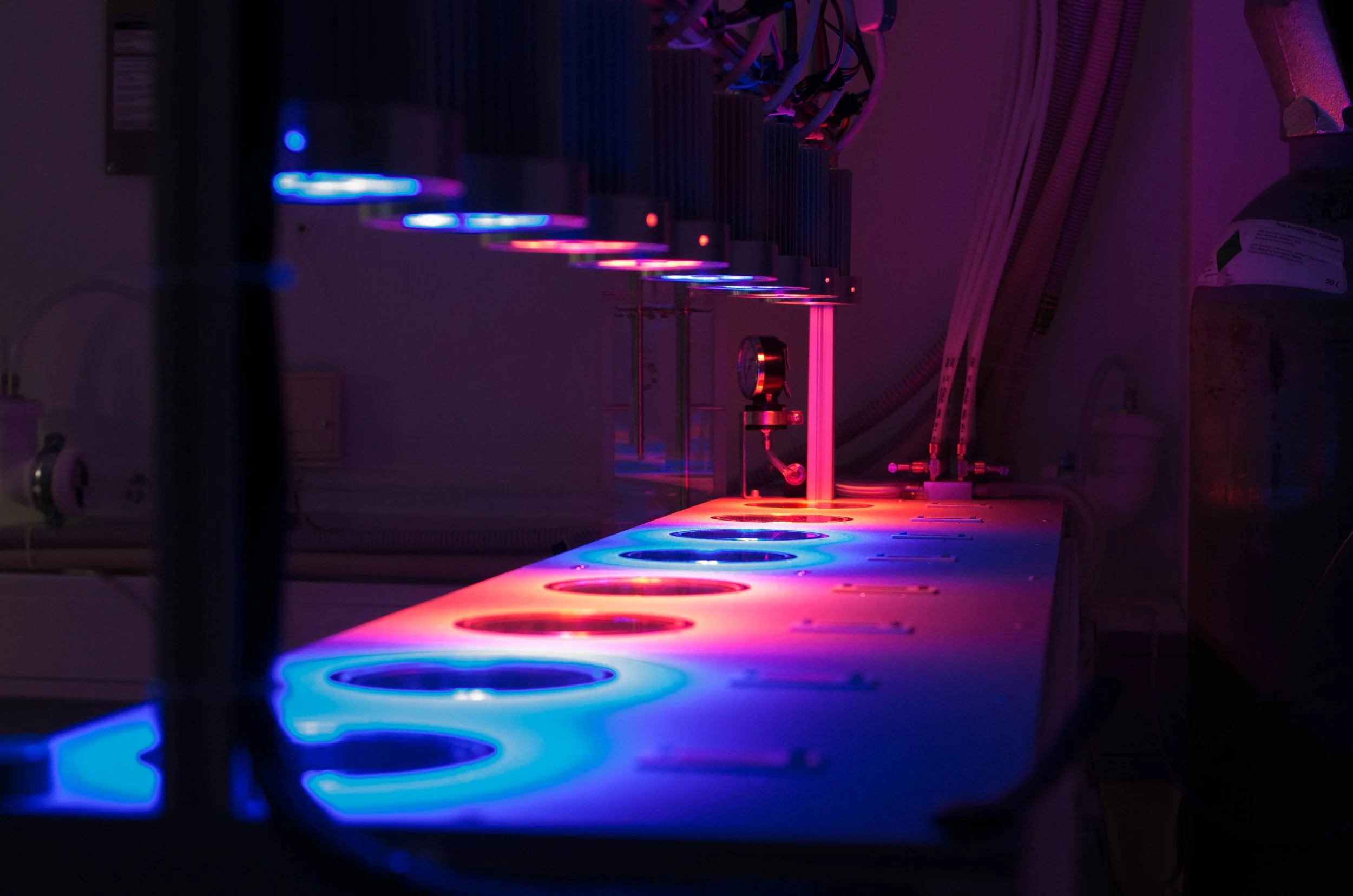
Jyrkki and Jyrkki MAX are designed to acquire precise gas exchange data from multiple plant lines in a single experiment in laboratory settings. This is achieved by measuring up to 8 chambers in parallel and without limiting compromises in sampling rate (8 minutes for full cycle). Through carefully designed chambers and innovative plant growing techniques these systems enable measurements of whole plants, further improving the quality of the obtained data.
-
The constructed devices are suitable for observing the physiological status of plants to analyse their responses to changing environmental conditions such as adjustable CO2 concentrations, illumination and humidity, pollutants, hormones etc. Another advantage of the systems is the ability to monitor plants in the long-term, throughout the day or even over consecutive days under strictly controlled conditions with minimal supervision.
-
By focusing on whole-plant measurements, these systems can overcome the effects of plant handling, enabling experiments even with the most delicate species and accessions. This is especially relevant for scientific work on Arabidopsis, where phenotypically detrimental mutations inhibit single-leaf measurements, yet which provide the most valuable insight into plant gas exchange mechanisms. descripBy focusing on whole-plant measurements, these systems can overcome the effects of plant handling, enabling experiments even with the most delicate species and accessions. This is especially relevant for scientific work on Arabidopsis, where phenotypically detrimental mutations inhibit single-leaf measurements, yet which provide the most valuable insight into plant gas exchange mechanisms.

RESEARCH BACKED Used in 65+ peer-reviewed studies Research done with PlantInvent technology View publications
69 articles listed
2026
2025
2024
- Abscisic acid induces stomatal closure in horsetails
- Basal ABA signaling balances transpiration and photosynthesis
- Constitutive activation of ABA receptors in Arabidopsis reveals unique regulatory circuitries
- Stomatal CO2 responses at sub- and above-ambient CO2 levels employ different pathways in Arabidopsis
- Synthesis and import of GDP-l-fucose into the Golgi affect plant–water relations
2023
- A role for ethylene signaling and biosynthesis in regulating and accelerating CO2- and abscisic acid-mediated stomatal movements in Arabidopsis
- ALMT-independent guard cell R-type anion currents
- MPK12 in stomatal CO2 signaling: function beyond its kinase activity
- Phenotypic Variation and Relationships between Grain Yield, Protein Content and Unmanned Aerial Vehicle-Derived Normalized Difference Vegetation Index in Spring Wheat in Nordic–Baltic Environments
- Plants lacking OST1 show conditional stomatal closure and wildtype-like growth sensitivity at high VPD
- Structure-guided engineering of a receptor-agonist pair for inducible activation of the ABA adaptive response to drought
2022
- Elevated CO2 induces rapid dephosphorylation of plasma membrane H+-ATPase in guard cells
- Phosphorylation of plasma membrane H+-ATPase AHA2 by BAK1 is required for ABA-induced stomatal closure in Arabidopsis
- Stomatal CO2/bicarbonate sensor consists of two interacting protein kinases, Raf-like HT1 and non-kinase-activity requiring MPK12/MPK4
- THESEUS1 modulates cell wall stiffness and abscisic acid production in Arabidopsis thaliana
2021
- A role for calcium-dependent protein kinases in differential CO2- and ABA-controlled stomatal closing and low CO2-induced stomatal opening in Arabidopsis
- Combined action of guard cell plasma membrane rapid- and slow-type anion channels in stomatal regulation
- Jasmonic acid and salicylic acid play minor roles in stomatal regulation by CO2, abscisic acid, darkness, vapor pressure deficit and ozone
- Multiparameter in vivo imaging in plants using genetically encoded fluorescent indicator multiplexing
- Raf-like kinases and receptor-like (pseudo)kinase GHR1 are required for stomatal vapor pressure difference response
- Rapid depolarization and cytosolic calcium increase go hand-in-hand in mesophyll cells’ ozone response
2020
- Differential role of MAX2 and strigolactones in pathogen, ozone, and stomatal responses
- FRET kinase sensor development reveals SnRK2/OST1 activation by ABA but not by MeJA and high CO2 during stomatal closure
- Genetic controls of short- and long-term stomatal CO2 responses in Arabidopsis thaliana
- STRESS INDUCED FACTOR 2 Regulates Arabidopsis Stomatal Immunity through Phosphorylation of the Anion Channel SLAC1
2019
- A ligand-independent origin of abscisic acid perception
- Calcium signals in guard cells enhance the efficiency by which abscisic acid triggers stomatal closure
- The MATH-BTB BPM3 and BPM5 subunits of Cullin3-RING E3 ubiquitin ligases target PP2CA and other clade A PP2Cs for degradation
- The role of Arabidopsis ABA receptors from the PYR/PYL/RCAR family in stomatal acclimation and closure signal integration
2018
- ABA-mediated regulation of stomatal density is OST1-independent
- Abscisic acid-independent stomatal CO2 signal transduction pathway and convergence of CO2 and ABA signaling downstream of OST1 kinase
- Arabidopsis MLO2 is a negative regulator of sensitivity to extracellular reactive oxygen species
- Gas exchange-yield relationships of malting barley genotypes treated with fungicides and biostimulants
- Mitogen-activated protein kinases MPK4 and MPK12 are key components mediating CO2-induced stomatal movements
- The Receptor-like Pseudokinase GHR1 Is Required for Stomatal Closure
2017
- A Rationally Designed Agonist Defines Subfamily IIIA Abscisic Acid Receptors As Critical Targets for Manipulating Transpiration
- Fern Stomatal Responses to ABA and CO2 Depend on Species and Growth Conditions
- The Role of ENHANCED RESPONSES TO ABA1 (ERA1) in Arabidopsis Stomatal Responses Is Beyond ABA Signaling
2016
- A Dominant Mutation in the HT1 Kinase Uncovers Roles of MAP Kinases and GHR1 in CO2-Induced Stomatal Closure
- BODYGUARD is required for biosynthesis of cutin in Arabidopsis
- Natural Variation in Arabidopsis Cvi-0 Accession Reveals an Important Role of MPK12 in Guard Cell CO2 Signaling
- The Breakdown of Stored Triacylglycerols Is Required during Light-Induced Stomatal Opening
2015
- A specialized histone H1 variant is required for adaptive responses to complex abiotic stress and related DNA methylation in Arabidopsis
- Guard cell SLAC1-type anion channels mediate flagellin-induced stomatal closure
- Large-Scale Phenomics Identifies Primary and Fine-Tuning Roles for CRKs in Responses Related to Oxidative Stress
- The F-box protein MAX2 contributes to resistance to bacterial phytopathogens in Arabidopsis thaliana
- The Role of ABA Recycling and Transporter Proteins in Rapid Stomatal Responses to Reduced Air Humidity, Elevated CO2, and Exogenous ABA
2014
2013
- Calcium-Dependent and -Independent Stomatal Signaling Network and Compensatory Feedback Control of Stomatal Opening via Ca2+ Sensitivity Priming
- Defense-related transcription factors WRKY70 and WRKY54 modulate osmotic stress tolerance by regulating stomatal aperture in Arabidopsis
- Identification of Cyclic GMP-Activated Nonselective Ca2+-Permeable Cation Channels and Associated CNGC5 and CNGC6 Genes in Arabidopsis Guard Cells
- Mutations in SLAC1 anion channel slow stomatal opening and severely reduce K+ uptake channel activity via enhanced cytosolic [Ca2+] and increased Ca2+ sensitivity of K+ uptake channels
- PYR/RCAR Receptors Contribute to Ozone-, Reduced Air Humidity-, Darkness-, and CO2-Induced Stomatal Regulation
- The PYL4 A194T Mutant Uncovers a Key Role of PYR1-LIKE4/PROTEIN PHOSPHATASE 2CA Interaction for Abscisic Acid Signaling and Plant Drought Resistance
2012
2011
2010
- Natural variation in ozone sensitivity among Arabidopsis thaliana accessions and its relation to stomatal conductance
- Ozone-triggered rapid stomatal response involves production of reactive oxygen species, and is controlled by SLAC1 and OST1
- Stomatal action directly feeds back on leaf turgor: new insights into regulation of plant water status from non-invasive pressure probe measurements